
Pub History · 29 September 2026
Painted Lions and Golden Crowns: The Story Behind Britain’s Pub Signs
If you take a stroll through almost any British town or village, you can barely go two hundred yards without seeing a wooden board swinging gently in the wind. A painted red lion roaring from an iron bracket, a golden crown glinting in the morning sun, or a black swan gliding across dark water.
If you take a stroll through almost any British town or village, you can barely go two hundred yards without seeing a wooden board swinging gently in the wind. A painted red lion roaring from an iron bracket, a golden crown glinting in the morning sun, or a black swan gliding across dark water.
We take pub signs for granted nowadays. They are so woven into our scenery that they almost feel like street furniture.
When you run an inn that has stood on the same spot since 1307 four generations of our family have kept watch beneath our roof, and even though we are hidden in the valley and do not posses a pub sign... I’ve always loved the story of how pub signs came to be. It wasn’t a trendy marketing idea or a brewer’s branding exercise. It came down to royal law, royal inspectors, and a clever way of making sure everyone in the village was included.
To understand why pub signs are so visual, you have to rewind to the late fourteenth century, a few decades after our doors first opened.
Back then, brewing was informal. In villages across the country, local alewives would brew a batch of ale in small stone outhouses and stick an "ale-stake" which was a long wooden branch with a bundle of ivy or twigs tied to the top, outside their front doors. That stake told the neighbours that a fresh brew was ready to drink.
The trouble was that not all ale was good ale. Some batches soured, some were weak and watery, and some dishonest brewers even tried stretching their profits by cutting it with suspect ingredients.
In 1393, King Richard II decided that enough was enough. He passed an Act of Parliament that changed the British landscape forever. The law decreed that anyone brewing ale for sale must hang an identifiable sign outside their premises.
The reason was surprisingly practical and that reason was quality control haha.
Each district had an official called the "Ale Conner" or "Ale Taster." It was this inspector's job to visit every tavern, test the strength and purity of the brew, and make sure folk weren't being short-changed or poisoned. I mean what a job! Sounds a bit like what Grandma Betty used to do but without the title!! According to folklore, an ale-conner would wear leather breeches, pour a puddle of ale onto a wooden bench, and sit in it for half an hour. If his trousers stuck to the wood when he stood up, the ale had too much unfermented sugar and was deemed poor quality. If he could stand up cleanly, the brew passed muster.
King Richard’s new law made sure the Ale Conner couldn't claim he couldn't find the brewhouse. The inn had to display a sign for all to see or risk having its ale confiscated.
There was just one catch. In fourteenth-century England, the vast majority of ordinary working folk could neither read nor write. A sign that simply had the name of the inn written in lettering would have been useless to the carters, shepherds, weavers and travellers passing through.
So the answer to that was that the landlords had to turn to pictures.
They needed bold, striking images that anyone could recognise instantly from a distance, even through the driving rain or the thick Yorkshire mist.
Many of the earliest picture signs borrowed from royal heraldry, often as a show of loyalty to the Crown. The "Red Lion," which remains the most common pub name in the country to this day, became hugely popular when King James VI of Scotland took the English throne as James I and ordered his red lion heraldic crest to be displayed on prominent buildings. The "White Hart" was the personal badge of Richard II himself. The "Crown" was a safe bet for any publican wanting to stay in the good books of the reigning monarch, while the "Rose and Crown" celebrated the end of the Wars of the Roses.
Other signs were rooted in the everyday working lives of the locals who drank there. You’d spot the "Blacksmith’s Arms," the "Plough," or the "Woolpack," each proudly displaying the tools and trades of the community. In an era when travel was slow and confusing, a visual sign served as a crucial landmark. A traveller arriving late in the evening didn't need to read a map; they were told to look for the wooden boar or the brass sun hanging over the road.
What started as an inspector’s shortcut gradually evolved into one of the richest, most enduring traditions of British folk art. Local artists, blacksmiths, and woodcarvers poured their skills into creating intricate, double-sided painted boards and hand-forged wrought iron brackets, many of which were built to withstand centuries of gales.
Over seven hundred years on, the world has moved at a dizzying pace. We read signs on glowing smartphone screens, navigate by satellite, and order drinks through digital apps at a lot of pubs but we here at the 'Bridge try deperately to avoid the pressures of modern technology where possible!
Next time you look up at a painted lion, a swan, or a crown swinging in the breeze, spare a thought for the old Ale Tasters and the medieval publicans who hung them there. It’s seven centuries of folk art, community pride, and honest hospitality, still hanging above our heads today.
More from the inn
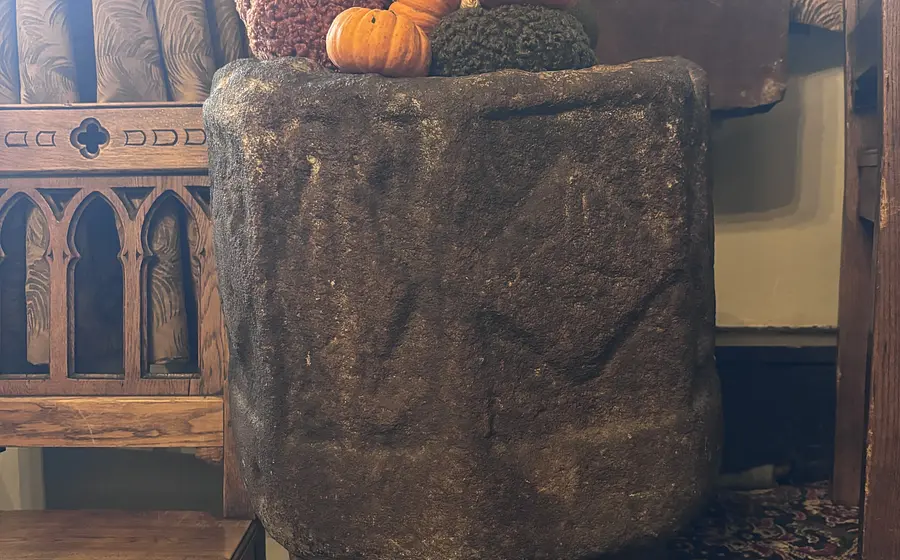
The Saxon Font in Our Bottom Bar: A Mystery Unearthed
If you’ve ever had a drink down in the bottom bar, chances are your pint has rested somewhere near a rather hefty piece of carved gritstone that looks like it belongs in an...
Read story
Tim bobbin: Who Was Tim Bobbin?
Tim Bobbin was the pen name of John Collier (1708–1786), a schoolmaster, artist, caricaturist and writer. Born in Urmston, he spent much of his working life teaching in Milnrow,...
Read story
The Village Stocks: Have You Seen Them?
Right outside our front door, you can’t miss the stocks. Most folk stroll past them on a sunny afternoon with a pint, have a bit of a laugh, and take turns posing for a photo....
Read story