
Pub History · 05 October 2026
The Oak Beam in the Bottom Bar: Spanish Armada or a Very Good Story?
Grandma Betty told a good tale and the more she supped the profits the better those tales became, people would just visit to see her. One that really stands out though is the story of the beam in the bottom bar...
If you’ve ever sat in the bottom bar, you’ll have seen it the great and magnificent old oak beam, dark with age and absolutely full of character and ancient coins. It’s one of those things people naturally notice. You sit down with a pint, look up, and immediately start wondering where it has been, what it has seen and how on earth it is still doing its job after all these years.
Now, the family story passed down from Grandma Betty (Barrett) which has also been repeated often enough over the years... is that the oak came from a ship in the Spanish Armada.
It’s a brilliant story. The Spanish Armada was defeated in 1588, and somewhere along the way the idea grew that timber from one of its ships found its way here and became part of the inn. It certainly makes for a good tale over a drink.
However, if we’re being sensible for a moment, it does raise a few questions. How would a huge, heavy, salt-soaked timber from a wrecked Spanish ship have made its way inland to Yorkshire? And why would anyone go to the trouble of hauling it all that way when there was excellent oak much closer to home?
The honest answer is: we don’t know. There is no written proof that our beam came from the Spanish Armada, and it is probably unlikely. Not impossible, perhaps, old buildings have been repaired, altered and added to many times over the centuries but unlikely without proper evidence. Still, when a building has been standing since 1307, you are allowed the odd tale that is just a little better than the truth.
What we do know is that the beam is part of what is known as a cruck, sometimes called a crook and arch structure.
A cruck frame uses naturally curved timbers, usually oak, which lean towards each other and support the roof. Imagine two long, bowed tree trunks rising from either side of the building and meeting high above your head, creating a great curved shape like an arch or an “A”. These pairs of curved timbers helped carry the weight of the roof and were commonly used in medieval buildings, from homes and inns to barns and halls.
Rather than seeing a curved piece of timber as something to cut away or discard, medieval builders used the natural shape of the tree to their advantage. They chose oak that had grown with the right bend, then worked with it. It is clever, practical craftsmanship and it is why the structure has such a distinctive, slightly wonky, beautiful feel to it today.
Cruck-framed buildings were especially associated with medieval England and Wales. The oldest surviving examples that have been accurately dated by tree-ring analysis go back to around the thirteenth century, so this style of construction fits very comfortably with the age and character of an inn that has been here for more than 700 years.
Of course, that does not mean every piece of timber here dates from 1307. Buildings like ours have lived long, hard-working lives. Roofs are repaired, beams are strengthened, walls are altered, and generations leave their mark. That is part of the story too. The fact that the building has survived at all is down to the care, hard work and occasional ingenuity of the people who have looked after it through the centuries.
And then there is the beam itself, peppered with coins hammered into the old oak. Nobody seems entirely sure when the tradition began, but folklore has a way of filling in the gaps. The story goes that once a coin has been pressed into the beam, it must stay there. Remove one, and you’ll be cursed forever mwahahahaha!!!
We have never been keen to test that one out, so please keep any penknives firmly in your pocket.
There is plenty of history in these walls, from the old priest hole (story still to come) to the family stories that have grown a little taller with every generation. We are now the fourth generation of our family to look after this place, and we will happily admit that Grandma’s stories may have gained a little extra sparkle along the way. But that is half the fun, isn’t it?
So, was the oak beam really part of the Spanish Armada?
Probably not. But it might be. And until someone turns up with a ship’s log, a Spanish sailor’s diary and a receipt for delivery to Yorkshire, we think it is a story worth keeping alive.
If you see one of the family about, ask us about it. We do love a tale especially with a 1/2 pint in a barrelled glass just like Grandma.
More from the inn
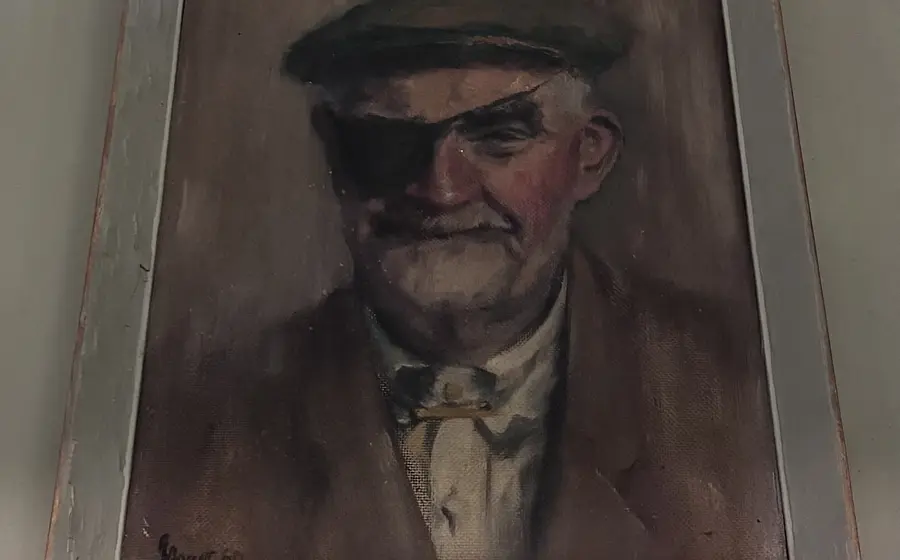
Ted Banks: The Man in the Painting in Our Middle Bar
Not all the history in an old pub belongs to the building. Sometimes it belongs to the people in the pictures.The painting of Ted Banks in our middle bar is a lovely example. My...
Read story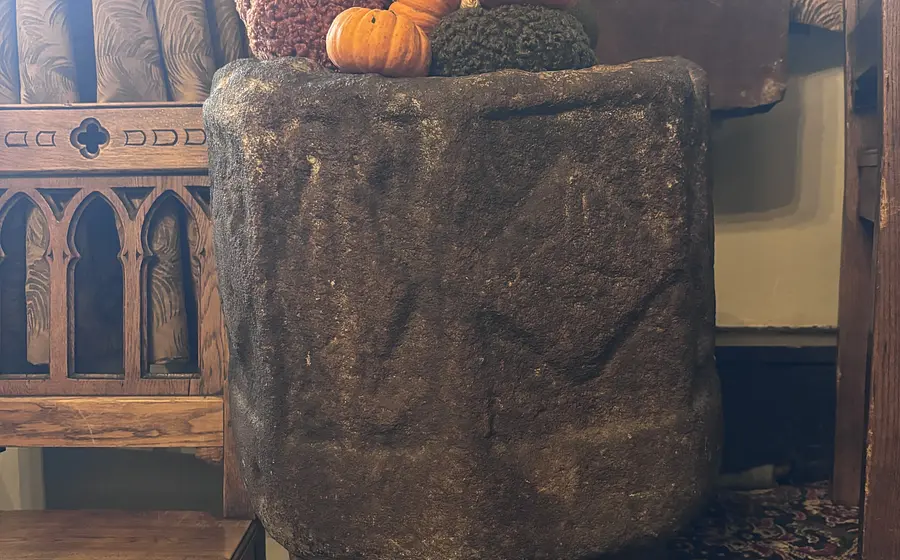
The Saxon Font in Our Bottom Bar: A Mystery Unearthed
If you’ve ever had a drink down in the bottom bar, chances are your pint has rested somewhere near a rather hefty piece of carved gritstone that looks like it belongs in an...
Read story
Tim bobbin: Who Was Tim Bobbin?
Tim Bobbin was the pen name of John Collier (1708–1786), a schoolmaster, artist, caricaturist and writer. Born in Urmston, he spent much of his working life teaching in Milnrow,...
Read story